If you’ve been dealing with pixelated channels, E48-32 errors, or a tangle of coax cables running across your building’s facade, there’s a cleaner, more reliable solution. For residents looking for a DSTV over fiber setup in Cape Town, DStv over fibre setup is transforming how Cape Town homes, apartments, and commercial sites receive satellite TV. This guide walks you through everything you need to know about fibre-based DStv distribution.
How a DStv Over Fibre Setup Works
For Cape Town homeowners and body corporates, DStv over fibre means your building uses one professionally installed communal dish on the roof instead of dozens of individual dishes. The satellite signal travels through fibre optic cable rather than traditional copper coax, delivering stable HD and 4K channels to every unit. Fibre optic distribution systems fill the need for reliable, low-loss, and future-proof satellite distribution infrastructure, especially in large or communal installations, effectively filling the gap left by traditional coaxial cabling.
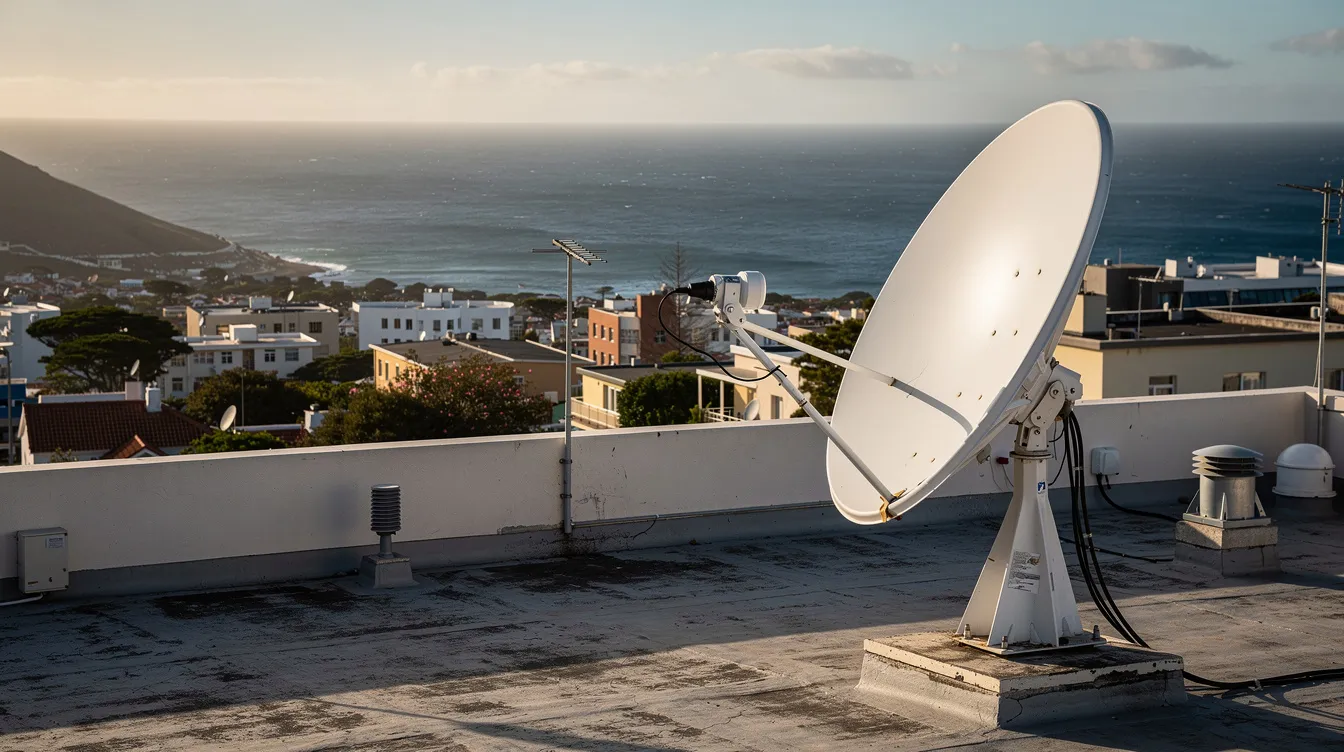
- A communal satellite dish (typically 80–90 cm in Cape Town) captures the DStv signal and feeds it to a fibre headend located on the roof or in an equipment room
- The headend converts satellite IF signals into light, which is then distributed via fibre optic cable through the building’s risers and ducts to each unit
- At each apartment or home, an optical receiver (also called an optical node) converts the light back to RF that plugs directly into your DStv decoder—this plug-and-play system requires no additional configuration, making installation quick and easy
- End users still use standard Multichoice decoders (Explora Ultra, Explora 3A, HD Single View) and subscriptions—only the cabling and distribution method change
- Main benefits include stronger, more stable signal over long distances, reduced cable clutter, and better suitability for multi-unit dwellings and new developments. Fiber optic installations are a reliable source of cabling with minimal wear and tear, resulting in less maintenance over time.
- Sat Digital provides complete on-site design, installation, upgrading, and repairs for DStv over fibre systems across Cape Town and the Western Cape
What Is DStv Over Fibre? (Basics Explained)
DStv over fibre is a modern way to distribute satellite TV throughout a building or estate using fibre optic cable instead of traditional copper coaxial cable. Think of it as an upgrade to the backbone of your DStv system—the channels, decoder, and subscription all stay the same, but the signal travels more efficiently from dish to decoder.
- Traditional DStv: Each unit has its own dish and LNB, or a communal dish uses coax cables running to every apartment (often requiring four separate cables per decoder)
- DStv fibre distribution: A single communal dish feeds a fibre headend that converts the satellite signal to light, then distributes it via thin fibre cable throughout the property
Note: When switching from traditional coaxial to fibre, ensure your decoder and internal wiring are compatible with fibre optic distribution systems, as some older equipment may require upgrades or adapters.
- The system carries satellite IF frequencies as optical signals over single-mode fibre using wavelengths such as 1310 nm and 1550 nm—this is standard telecommunications technology adapted for satellite TV. Fiber optic technology allows for the transmission of data, voice, and multimedia with less maintenance and near zero power consumption.
- This is not streaming or internet TV—it’s still satellite DStv, just transported on fibre instead of copper coax cable
- Typical use cases in Cape Town include apartment blocks in Century City, gated estates in Durbanville, office parks in Tygervalley, and guesthouses along the Atlantic Seaboard
- Most DStv fibre systems are passive—no powered amplifiers sit between the headend and units—which means lower maintenance and reduced power consumption for body corporates
- The system is fully compatible with modern decoders including Explora Ultra, Explora 3A, and DStv HD decoder models, as well as Unicable/SATCR technology for multi-tuner setups. This forward-looking approach ensures your DStv installation is future-proof and ready for ongoing technology upgrades.
Types of DStv Over Fibre Setups
Installers typically implement either pure fibre or hybrid fibre–coax solutions depending on building layout, existing infrastructure, and budget. Understanding the options helps trustees and developers make informed decisions.
- Pure fibre to the unit: Fibre runs from the communal headend directly to an optical termination inside each apartment or home, providing end-to-end fibre connectivity
- In pure fibre setups, the optical receiver sits in the lounge or comms cupboard, connected to the DStv decoder via a short coax patch lead (typically under 3 metres)
- Hybrid fibre–coax: Fibre extends from the roof to intermediate distribution points (riser cabinets or basement rooms), then existing RG6 coax reaches each unit’s TV point
- Hybrid systems are common in older Cape Town apartment blocks where coax risers already exist and remain in good condition—reusing them saves significant cost
- For large or wide premises like residential estates, multi-satellite or multi-service fibre can carry DStv, OpenView, CCTV, and data on separate wavelengths over shared infrastructure
- Multi-service fibre is increasingly popular in mixed-use developments where a single cabling system serves multiple purposes
| Feature | Pure Fibre | Hybrid Fibre–Coax |
|---|---|---|
| Signal quality | Highest end-to-end | Good (depends on coax condition) |
| Installation cost | Higher upfront | Lower for retrofits |
| Best for | New builds, large complexes | Older buildings with existing coax |
| Typical Cape Town use | Century City towers, new estates | 1980s blocks in Sea Point, Bellville |
| Distance capability | Hundreds of metres with minimal loss | Fibre backbone + short coax runs |
Key Components in a DStv Over Fibre Installation
Understanding the hardware involved helps you evaluate quotes and communicate with installers. Here’s what goes into a professional DStv over fibre setup:
- Satellite dish: Typical sizes in the Western Cape are 80–90 cm for standard HD installations; 1.2 m dishes serve high-density complexes or commercial sites exposed to strong wind and heavy rain
- LNB (Low Noise Block): A universal or quattro LNB feeds the fibre headend, splitting the satellite signal into vertical/horizontal and high/low bands for complete channel coverage. The system manages four different signal quadrants (polarities) to ensure full channel coverage and future scalability.
- Optical transmitter / fibre headend: This critical component converts RF satellite IF signals into optical signals—Multichoice-approved units ensure compatibility and ongoing support. A switch, such as a 5-in-1 or 5-in-2 switch, is used to convert multiple coaxial cables carrying different polarities into a single cable signal for advanced decoder setups like Unicable or SATCR.
- Single-mode fibre optic cable (OS2): The recommended design uses armoured fibre for outdoor runs, protecting against Cape Town’s coastal conditions, UV exposure, and accidental damage
- Fibre splitters and distribution frames: Installed in risers or basement comms rooms, these passive components split the optical signal to serve multiple units without requiring power
- Optical nodes/receivers: Located inside each unit, these convert light back to coax IF suitable for DStv Explora and HD decoders
- Passive outlets, patch cables, and F-connectors: Proper terminations using quality RG6 coax and weatherproof connectors ensure long-term reliability at the final connection point
Step-by-Step: How We Install DStv Over Fibre
The installation of DSTV over fiber requires consultation with a DSTV systems engineer to determine the most favorable installation type.
Here’s how a typical Cape Town project unfolds—imagine a 40-unit block in Goodwood that’s been experiencing persistent signal issues and wants to upgrade from an aging coax system.
- Initial consultation: We assess the number of units, decoder types required, Extra View or Multi-Room requirements, and inspect existing conduit space and risers for fibre routing options
- Site survey: Our team checks potential dish locations for clear line of sight to DStv’s IS-20/IS-36 satellites, evaluates roof access and safety requirements, and maps fibre routes from roof to basement and units. During this step, installers may find obstacles or challenges such as difficult cable pulls or limited conduit capacity, which need to be addressed to ensure a successful setup.
- System design: We calculate optical budgets to ensure signal at units stays above minimum thresholds (typically above −15 dBm), determine splitter ratios, and select dish size based on Cape Town rainfall patterns and user density
- Dish and LNB installation: The communal dish is mounted on stable brackets using corrosion-resistant hardware, then precisely aligned to achieve quality readings above 80% on HD transponders
- Headend commissioning: The optical transmitter is installed in a weather-protected area with proper ventilation, neat cable management, and clear labelling for future maintenance
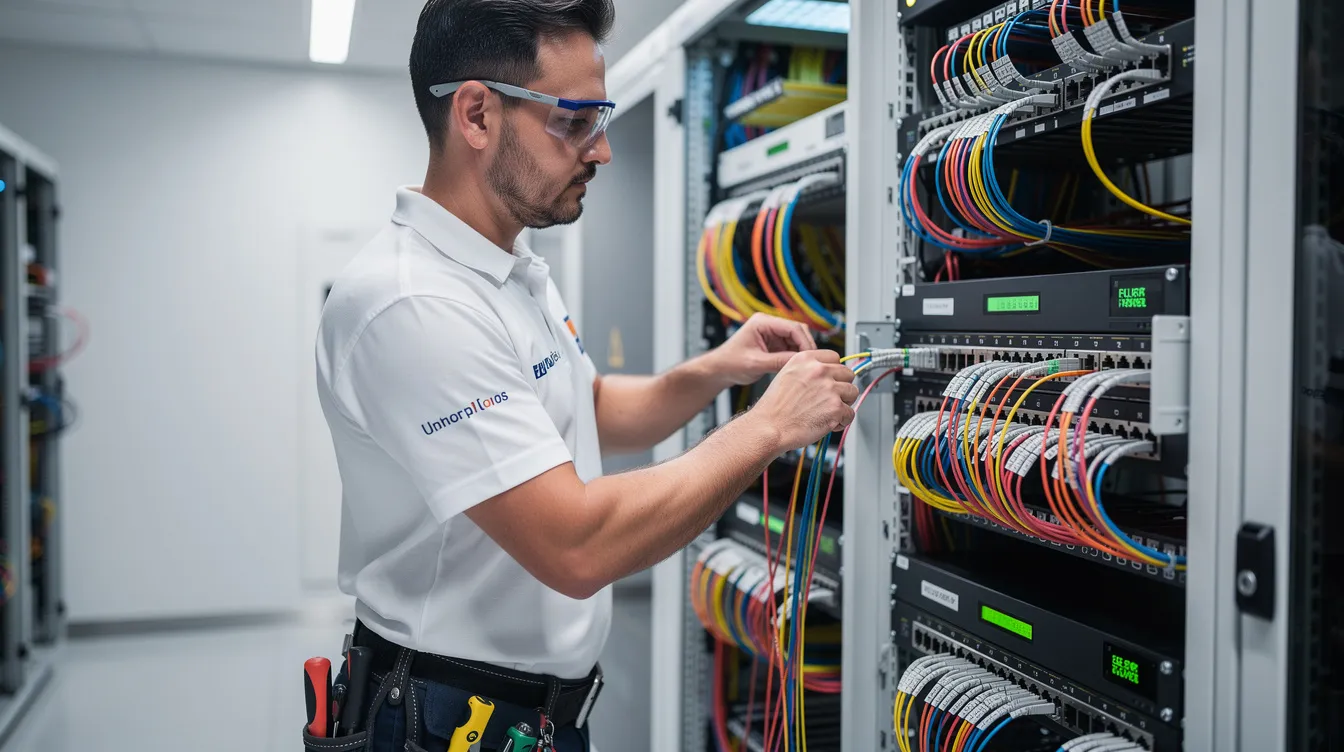
- Fibre installation: We pull and terminate fibre using proper bend radius techniques, avoiding tight corners in conduits, then clean and test every connector with a power meter
- Unit receivers: Optical receivers are installed in individual apartments and connected to decoders via short coax runs, with correct Unicable outputs configured for multi-tuner setups
- Final testing: We verify channel quality on all major bouquets, confirm no E48-32 errors appear, and test Extra View / Unicable settings across the complex
- Handover: Sat Digital provides trustees with as-built diagrams, port labels, and basic troubleshooting documentation for building managers
Why Choose DStv Over Fibre Instead of Coax?
For Cape Town homes, multi-dwelling units, and commercial clients, DStv fibre offers practical advantages that directly address common frustrations with traditional cabling.
- Lower signal loss: Fibre maintains stable signal quality over hundreds of metres, while coax degrades significantly—essential for large estates and high-rise buildings
- Simplified cabling: A single fibre strand replaces the up to four coaxial cables required by modern decoders, dramatically reducing conduit and riser requirements
- Interference resistance: Fibre is immune to electromagnetic interference and lightning-induced surges that plague long coax runs in coastal, storm-prone areas like Blouberg and Muizenberg
- Cleaner aesthetics: Less visible cabling on building facades and balconies satisfies body corporates and architects who prioritise building appearance
- Future-proof infrastructure: Fibre-ready buildings adapt easily as Multichoice increases channel capacity or introduces new decoder technology
- Developer benefits: Installing DStv over fibre during construction avoids expensive re-cabling later and meets modern buyers’ expectations for connected homes
Multi-Unit Dwellings & Commercial Sites in the Western Cape
Body corporates, HOAs, hotels, guesthouses, and office parks across Cape Town and surrounding towns (Stellenbosch, Paarl, Somerset West) benefit most from centralised fibre distribution.
- Communal dish policy: One correctly-sized dish on the roof replaces dozens of individual dishes on balconies, improving aesthetics and eliminating structural concerns from multiple penetrations
- Multichoice MUD guidelines: Following standard multi-unit dwelling guidelines ensures compatibility with current and future DStv services, maintaining eligibility for Multichoice support
- Typical complex types: Student housing near UCT, mixed-use buildings in the CBD, coastal holiday apartments in Bloubergstrand, and boutique hotels in Camps Bay
- Multi-decoder support: Sat Digital designs systems supporting multiple decoders per unit, Extra View configurations, and DStv Business packages for sports bars and restaurants
- Real-world example: A 60-unit estate in Durbanville converted from cascaded coax multiswitches to fibre after persistent E48-32 errors during rain—after the upgrade, complaints dropped to near zero
- Easier maintenance: Centralised fibre infrastructure means faster emergency repairs and less disruption for residents and guests when issues arise

Common Cabling Challenges & How Fibre Solves Them
Older Cape Town buildings present unique challenges: limited conduits, tight bends, corrosion from sea air, and decades of accumulated messy cabling. Fibre addresses these issues directly.
| Challenge | Coax Problem | Fibre Solution |
|---|---|---|
| Limited conduits | Can’t fit four new cables per unit | Single thin fibre handles everything |
| Long vertical runs | Significant signal attenuation | Negligible loss over hundreds of metres |
| Tight bends | Signal degradation at corners | Bend-insensitive fibre routes easily |
| Coastal corrosion | Exposed connectors corrode rapidly | Protected terminations in sealed enclosures |
| Water ingress | Degrades coax over time | Properly ducted fibre resists moisture |
- Many 1970s–1990s blocks have undersized PVC conduits that physically cannot accommodate four new coax cables per unit for modern Explora decoders
- Single-mode fibre’s small diameter and bend-tolerant designs allow routing through existing narrow ducts where coax simply won’t fit
- Long vertical coax runs in high-rise buildings introduce significant attenuation and tilt, causing pixelation and intermittent E48-32 errors on upper floors
- Fibre’s negligible loss (approximately 0.3 dB per kilometre) delivers consistent signal quality even across large complexes or campus-style developments
- Sea Point example: An older block with exposed coax running between balconies experienced regular failures during winter storms—after converting to fibre with protected routing, the system has operated reliably through multiple storm seasons
Technical Notes: Signal Levels, Wavelengths & Equipment
This section provides technical detail for building managers, engineers, and those comparing different system proposals.
- DStv fibre systems typically use 1310 nm or 1550 nm wavelengths for satellite IF distribution over single-mode OS2 fibre—1550 nm offers slightly lower attenuation for longer runs
- Optical receivers generally require input levels above approximately −15 dBm for reliable decoding; below this threshold, channels may drop or pixelate intermittently
- Optical budget calculation: Start with transmitter output power (typically +3 to +7 dBm), subtract fibre loss per kilometre (0.3–0.4 dB), connector losses (0.3 dB each), and splitter losses (e.g., 1×8 splitter ≈ 10.5 dB)
- Passive optical networks eliminate mid-span powered amplifiers, reducing failure points and energy costs—important for body corporates managing operating budgets
- Standard connector types include SC/APC (green) and FC/PC; proper cleaning tools and dust caps prevent contamination that degrades signal quality
- Dish size selection (80 cm vs 90 cm vs 1.2 m) depends on local rain-fade patterns and the number of users sharing the communal system—larger dishes provide more margin during heavy Western Cape winter storms
Integration With Extra View, OpenView & Other Services
Many Cape Town households run multiple decoders or combine DStv with OpenView, requiring careful system funneling to avoid additional dishes and cable clutter.
- Unicable / SATCR technology: Fibre receivers with Unicable outputs feed multiple tuners over a single cable, supporting Extra View and XtraView setups efficiently
- DStv over fibre can coexist with OpenView and other satellite services on the same infrastructure when planned with separate wavelengths or careful band allocation
- High-end developments and boutique hotels increasingly integrate IPTV, CCTV, and internet distribution alongside DStv on shared fibre infrastructure
- Sat Digital handles decoder upgrades, Smart LNB changes, and TV wall mounting as part of a single integrated project—avoiding multiple contractor visits
- When DStv and data services share ducts or racks, coordination with ISPs and building IT managers ensures clean installation and proper labelling for future work
Typical Costs, Timeframes & Maintenance
Exact pricing depends on site-specific factors, but understanding what drives costs helps trustees and developers budget appropriately.
Main cost drivers include:
- Dish size and mounting complexity
- Number of units and decoders required
- Distance between blocks or housing clusters
- Whether new conduits are needed or existing ones can be reused
- Pure fibre vs hybrid design choice
Typical timeframes:
- Small block (10–20 units in Bellville): 1–3 days after approval and access arranged
- Medium complex (40–60 units): 3–7 days depending on riser access
- Large estate: 2–4 weeks for phased installation
Maintenance requirements:
- Periodic dish alignment checks after Cape storms
- Visual inspection of fibre terminations in distribution frames
- Signal level testing if any units report issues
- Passive fibre systems have significantly fewer failure points than cascaded coax multiswitch networks
Body corporates should retain as-built diagrams and ensure cabinet labelling remains legible—this speeds up any future repairs or expansions. Sat Digital offers ongoing support, signal troubleshooting, and emergency call-outs for both residential and commercial clients.
Why Work With Sat Digital for DStv Over Fibre in Cape Town?
Sat Digital focuses exclusively on Cape Town and the Western Cape, bringing local expertise to every installation.
- We’re familiar with Multichoice fibre guidelines and design systems that meet current standards while remaining adaptable for future DStv developments
- Our team handles the full lifecycle: new DStv over fibre installations, upgrades from coax, decoder setup and configuration, E48-32 error resolution, and system expansions
- We’ve completed projects across diverse sites—from single homes in Constantia wanting cleaner cabling to guesthouses in Blouberg and large residential estates in Northern Suburbs
- Transparent, upfront quotations with clear communication throughout the process—trustees, developers, and homeowners always know what to expect
- Recent project: A 45-unit complex in Milnerton had struggled with signal issues for years despite multiple repair attempts by different contractors. Sat Digital redesigned the system using fibre distribution, and residents now enjoy reliable HD channels with zero callbacks in the six months since installation
How to Book a DStv Over Fibre Assessment
Ready to solve your DStv signal problems or install a modern fibre distribution system? Sat Digital provides free site assessments across Cape Town and the Western Cape.
- Call or WhatsApp: Contact Sat Digital directly for quick responses to your DStv installer enquiries
- Email: Send building plans, body corporate documentation, or tender requirements for commercial and estate projects
- Simple contact form: Provide your name, complex or suburb, number of units/TV points, and current issues (E48-32 errors, pixelation, cable clutter)
- Service coverage: Cape Town CBD, Northern Suburbs, Southern Suburbs, Atlantic Seaboard, West Coast, Helderberg, and surrounding areas including Stellenbosch, Paarl, and Somerset West
Whether you’re a homeowner frustrated with unreliable signal, a trustee dealing with constant call-outs, or a developer planning a new complex, DStv over fibre delivers the stability and quality your property deserves. Contact Sat Digital today for expert DStv over fibre setup, repair, or upgrading—we’ll assess your site, explain your options clearly, and get your system running right.