Nothing ruins a Sunday afternoon quicker than your DStv cutting out right before kickoff. Missing out on news channels and current affairs updates is just as frustrating, especially when you rely on DStv for the latest headlines. If you’re staring at an E48-32 error or watching your picture freeze into blocky pixels, the problem is often simpler than you think. For many Cape Town households, the fix isn’t a new decoder or a call to MultiChoice – it’s precise dish realignment. If you’re experiencing these issues, a dstv dish realignment could restore your signal.
What Is DStv Dish Realignment & Why It Matters
DStv dish realignment is the process of re-aiming your existing satellite dish to the correct satellite position after wind, rust, poor mounting, or building changes have shifted it. Your dstv satellite dish must point at the orbital slot at 68.5° East with precision – even a shift of one or two degrees can cause complete signal loss or intermittent problems that drive you mad.
Common symptoms that indicate realignment is needed include DStv error E48-32 displaying “No signal” or “Searching for signal”, pixelated picture quality, channels freezing mid-programme, or situations where only some channels work while others show nothing. These issues rarely mean your decoder is broken. More often, the dish has drifted slightly off target.
For viewers in Cape Town and the wider Western Cape, accurate dish alignment is essential for HD sport on SuperSport, premium movies on M-net, and reliable streaming via Explora or DStv Stream. The coastal winds, salty air, and seasonal storms in this region make dishes particularly prone to movement and corrosion. What works perfectly in January can drift by April.
Sat Digital operates as local DStv specialists who realign, repair, and upgrade dishes for homes and businesses across Cape Town and the Western Cape. Our team understands the specific challenges of maintaining stable signal in this environment – from Camps Bay seaside properties to Stellenbosch wine estates.
How to Tell If Your DStv Dish Needs Realignment
Not every signal issue requires a new dish – many are fixed by precise realignment. Before assuming the worst, check whether your symptoms match these common signs:
- Frequent “Searching for signal” or E48-32 errors, especially during heavy rain or strong winds
- Only certain channels missing (such as SuperSport or M-Net) while others work fine
- Picture pixelation or sound cutting out, particularly in the evenings
- You recently moved the decoder, changed cables, or had building work done in the last 3–6 months
- Visible movement where the dish looks tilted, loose, or the bracket appears rusty
- Signal problems occurring at the same times every day
If signal issues follow a pattern – dropping out at 7pm daily or whenever wind comes from a particular direction – this typically indicates marginal alignment or partial obstruction rather than decoder failure. Your dish is operating right on the edge of acceptable signal quality and needs adjustment.
Sat Digital can test signal strength and signal quality on-site using professional equipment to confirm whether you’re dealing with an alignment problem, a failing LNB, or damaged cabling. This diagnostic approach saves you from guessing and potentially replacing hardware you don’t need to.
Understanding the Basics: Satellite Position, Elevation & LNB Skew
Good realignment comes down to three adjustments: azimuth (left/right position), elevation (up/down angle), and LNB skew (rotation of the low noise block downconverter). Get all three right and you’ll have clear reception. Miss any one by a few degrees and certain channels will drop out or pixelate.
DStv services in South Africa broadcast from satellites at 68.5° East longitude. For Cape Town, this means your dish generally points north-east with an elevation angle around the mid-30s degrees above the horizon. The exact azimuth angle depends on your specific location, but installers use calculators or a satellite finder app on a smartphone to determine precise coordinates for your property.
Here’s why precision matters:
- A 1-2° error in azimuth can cause loss of specific transponders, meaning some channel groups work while others show “no signal”
- Incorrect elevation reduces overall signal strength and leaves no margin for rain fade
- Wrong LNB skew affects polarization alignment – some channels may work perfectly while others are unwatchable
The skew adjustment involves rotation of the LNB head itself. Because DStv signals use both horizontal and vertical polarization, the LNB must be twisted to the correct angle for your location. In Cape Town, this is different from Johannesburg or Durban. A few degrees of skew correction can transform a “no signal” error into a strong, stable picture.
Professional installers use a signal strength meter and the decoder’s built-in signal menu to fine-tune both strength and quality readings. They don’t just aim for “some picture” – they target readings above 80-85% to ensure your system has margin for bad weather.
DStv Satellite Configuration: Getting the Settings Right
Getting your DStv satellite dish configuration right is crucial for enjoying uninterrupted viewing and the best possible signal quality. Whether you’re setting up a new dish or troubleshooting an existing one, attention to detail at every step makes all the difference between crystal-clear reception and frustrating “no signal” errors.
Start by selecting a stable surface for your dish mount—this could be a solid wall or a secure spot on your roof. Avoid areas where trees, buildings, or other obstacles could block the signal path, as even temporary obstructions can affect signal quality, especially during heavy rain or strong winds.
Next, determine the correct azimuth angle (the compass direction) and elevation angle (the vertical tilt) for your specific location in Cape Town or the Western Cape. You can find these coordinates on the DStv website or by using a satellite finder tool or app. With these angles in hand, carefully adjust your dish’s position, making small movements and checking that the bolts are tightened securely to prevent any unwanted movement over time.
Once the dish is roughly in place, connect the low noise block downconverter (LNB) to the arm of the dish. The LNB is essential for amplifying the satellite signal and ensuring strong, reliable reception. Use a signal strength meter to fine-tune the dish’s alignment—move the dish left, right, up, or down in tiny increments while monitoring the meter to lock onto the best signal. This precision is key to avoiding poor alignment, which can result in missing channels or pixelated images.
After you’ve achieved optimal signal strength, perform a channel scan on your decoder to ensure you’re receiving all available channels. If you notice any issues—such as missing channels or weak signal strength—it may be a sign that further adjustment is needed, or that environmental factors are temporarily affecting signal quality.
Don’t forget to regularly inspect your installation. Check that all bolts are tight, cables are undamaged, and the dish remains in its correct position. Cape Town’s weather can be tough on satellite equipment, so preventative maintenance is essential for long-term performance.
If you’re unsure about any step, or if you’re struggling to achieve clear reception despite your best efforts, it’s wise to call in the professionals. Sat Digital’s team has the right tools, experience, and local knowledge to ensure your DStv satellite dish is perfectly aligned and configured for your location. With expert support, you can enjoy reliable access to all your favorite channels—rain or shine.
For more tips, detailed guides, or to book a professional alignment, visit the DStv website or contact Sat Digital directly. With the right setup and ongoing care, your DStv satellite dish will deliver the best signal and a seamless viewing experience for years to come.
Step-by-Step: How Professionals Realign a DStv Dish
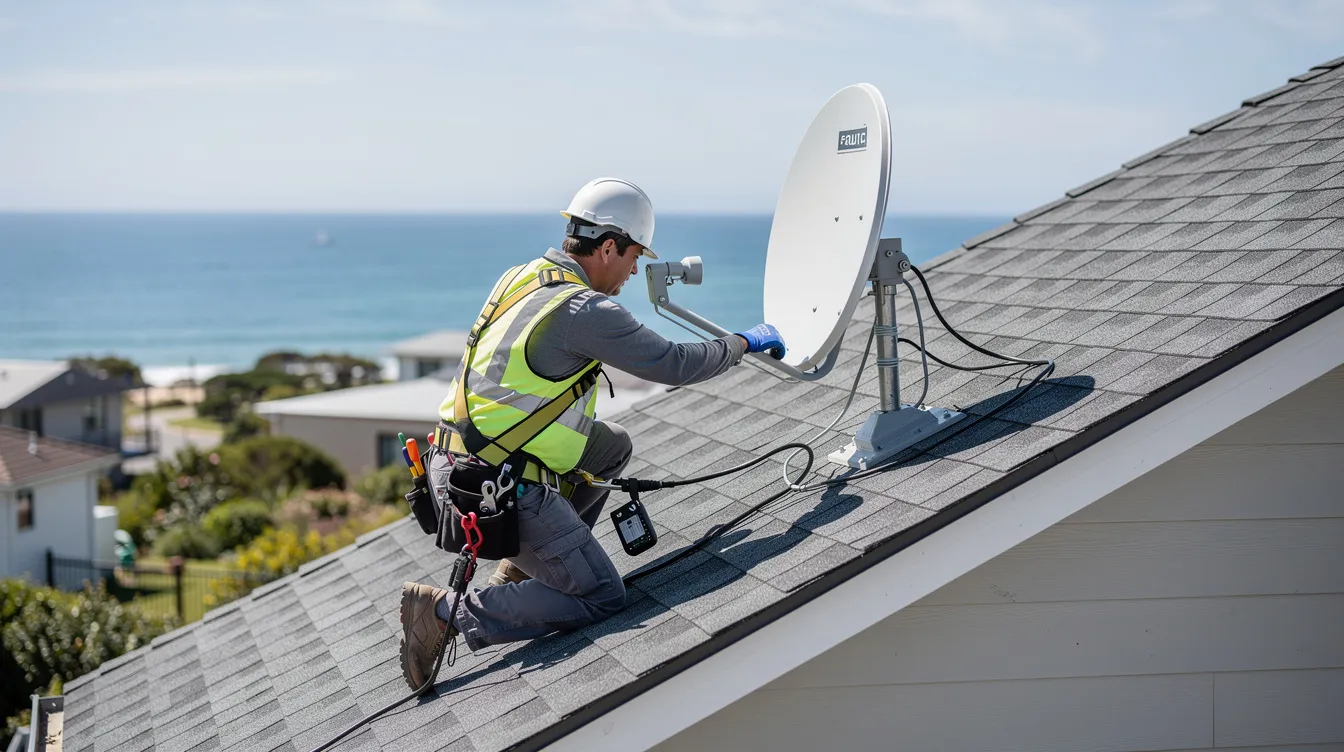
Roof work and dish adjustment involve real safety risks and are best left to accredited installers with proper equipment and safety gear. Here’s what Sat Digital typically follows on a realignment call-out in Cape Town:
- Inspect the installation – Check dish surface, bracket, dish mount, LNB arm, and cables for rust, cracks, bent components, or loose bolts
- Measure baseline signal – Use the decoder’s signal menu and a professional meter to check current strength and quality on key transponders
- Loosen mounting bolts – Slightly loosen adjustment bolts to allow controlled movement without the dish swinging freely
- Adjust azimuth – Use a compass bearing and satellite finder while watching the meter, moving the dish left or right in tiny increments until the best signal is achieved
- Adjust elevation – Tilt the dish up or down using the scale on the mount as a guide, fine-tuning until quality readings peak
- Correct LNB skew – Rotate the LNB slightly clockwise or counter-clockwise to optimise polarization alignment
- Tighten and secure – Lock all bolts firmly to withstand Cape Town coastal winds and prevent future drift
- Verify channels – Perform a channel scan if needed, check HD channels, extra view decoders, and confirm E48-32 errors no longer appear
A straightforward realignment with no part replacements typically takes 30-60 minutes from arrival to testing. More complex jobs involving access issues or hardware replacement take longer, but your technician will advise on-site.
Common Realignment Problems: When It’s Not Just the Dish
Sometimes a “realignment” call-out uncovers deeper hardware issues that must be fixed during the same visit. The dish position might be correct, but other components have failed.
Typical additional faults discovered during realignment include:
- Water-damaged F-connectors and coaxial cables – Corroded connectors are common on older Cape Town seaside properties where salty air accelerates rust. Symptoms include intermittent signal loss after rain.
- Cracked or failing LNB – A damaged low noise block downconverter causes intermittent signal even when alignment is perfect. UV exposure and temperature cycles crack the plastic housing over time.
- Bent dish or loose mast – Strong Cape storms can physically deform dishes or twist masts. A bent dish won’t focus correctly regardless of pointing angle.
- Poor original installation – Dishes mounted to flimsy fascia boards or using undersized poles move in wind. Some cheap installations have a functional lifespan as short as 18 months in coastal conditions.
- Signal path obstruction – Newly grown trees or recently built walls can block the clear line of sight to the satellite, requiring repositioning rather than simple realignment.
Sat Digital can replace LNBs, re-route cables, and install sturdier brackets in one call-out to prevent your signal dropping again after a few weeks. If obstacles block the sky in your current dish location, we can advise on repositioning to a better spot on your property.
DIY vs Professional DStv Dish Realignment in the Western Cape
The internet has plenty of guides suggesting you can align your own dish with a compass and some patience. While it’s theoretically possible, there are significant practical limitations – especially in Cape Town conditions.
Limitations of DIY approaches:
- No access to a proper signal strength meter, relying only on trial and error with the decoder’s on-screen bar
- Risk of falling from roofs or ladders, particularly dangerous in windy conditions common to the Cape
- Potential to overtighten or strip bolts, bend the dish, or damage the LNB and cables while adjusting
- Decoder settings for LNB type, unicable vs universal, and XtraView configurations are easily misconfigured without experience
- Hours of frustration on the roof when professional help could solve the problem in under an hour
Benefits of using Sat Digital:
- Accredited DStv installers familiar with Cape Town and Western Cape signal conditions and optimal mounting options
- Right tools and equipment including professional meters to diagnose whether the dish, LNB, cable, or decoder is actually at fault
- Ability to fix alignment correctly the first time and provide stable surface mounting that withstands local weather
- Transparent, upfront pricing and same-day or next-day service in most suburbs
- Support for complex setups including Explora, Extra View, and communal or guesthouse installations
For businesses like restaurants, sports bars, and hotels, DIY attempts during peak viewing times risk significant downtime and lost revenue. A major sporting event with no signal means unhappy customers and direct financial loss. Professional realignment is essential for commercial operations.
Related Services: Installation, Upgrades & Preventative Maintenance
Sat Digital offers more than signal fixing. Dish realignment often leads into broader optimization or upgrade work that improves your long-term viewing experience.
Complementary services relevant to readers dealing with dish issues:
- New DStv dish installation and relocations – Essential when properties are renovated, extended, or when current positioning has become obstructed
- OpenView HD installations and realignment – For customers switching platforms or running both systems simultaneously
- Decoder upgrades – Moving to DStv Explora with correct dish configuration and Smart LNB setup for multi-tuner functionality
- XtraView multi-room setups – Properly configured so multiple decoders can watch and record independently
- Cable and LNB replacement – Installing Quad or Smart LNBs to stabilise signal and support extra points throughout your home
- TV wall mounting – Neat cable management completed while technicians are already on-site
- Commercial and communal installations – Hotels, guest houses, apartment blocks, and offices across the Western Cape with master antenna systems
Whether you need a quick fix or a complete setup overhaul, addressing everything in one visit saves time and ensures all components work together correctly.
How Sat Digital Handles DStv Dish Realignment Bookings
Booking is straightforward: phone call, WhatsApp, or website contact form. Sat Digital serves Cape Town and nearby areas across the Western Cape, from the Atlantic Seaboard to the Winelands and beyond.
Here’s what to expect from the booking process:
- Describe your symptoms – Share error codes, weather-related issues, missing channels, and your location
- Receive a quote – Sat Digital provides a guideline price range and proposes an appointment window
- Technician arrives prepared – Ladders, safety gear, meters, and spare LNBs and cables in case replacements are needed
- Work is verified before leaving – Testing on key channels, signal readings shown to you, confirmation that everything works
Same-day service is often possible in major Cape Town suburbs. Outlying Western Cape towns may be scheduled for the next available route day to keep call-out costs reasonable for those areas.
Pricing is transparent with no hidden fees. If additional parts are needed, you’ll receive a quote before any work proceeds. This approach builds trust with both homeowners and small businesses who want to know costs upfront.
When to Realign vs Replace Your DStv Dish
Older or storm-damaged dishes may not be worth saving, even with perfect alignment. Here’s how to decide:
Realign when:
- The dish is physically intact with no major dents or warping
- Brackets are still sturdy and securely anchored into brick or concrete
- Rust is surface-level only, not causing structural weakness
- The dish mount and mast remain vertical and stable
Replace when:
- The dish is bent, has rust holes, or the surface is badly deformed
- The mounting pole is wobbling after years of Cape coastal weather exposure
- You’re upgrading to larger communal or commercial systems for hotels, lodges, or apartment complexes
- The original installation used undersized hardware that can’t withstand local conditions
Sat Digital can advise on-site whether it’s more cost-effective to realign or install a new dish. For HD viewing and Explora setups, we typically recommend 80cm dishes with appropriate Smart or Quad LNBs to provide rain fade margin and support multiple receivers.
A new dish plus proper mounting reduces future call-outs and provides years of reliable service. Sometimes the slightly higher upfront cost delivers far better value than repeatedly realigning equipment that’s past its useful life.
Book Professional DStv Dish Realignment with Sat Digital
Accurate DStv dish realignment restores lost channels, clears E48-32 “No signal” errors, and ensures stable viewing for families and businesses throughout Cape Town and the Western Cape. Whether your picture has been pixelating for weeks or you’ve just lost signal completely, the fix is often faster and simpler than you expect.
Contact Sat Digital for:
- Emergency “no signal” call-outs when you need your DStv working today
- Routine realignment and maintenance before major sports events or holiday seasons
- Full installation, decoder upgrades, and Openview setups
- Commercial installations for hotels, restaurants, and offices
As a local, experienced team, Sat Digital focuses on quality workmanship and reliable after-service support. We know Cape Town conditions, we carry the right equipment, and we get your signal back on target. Reach out via phone, WhatsApp, or our website page to book your realignment and get back to watching what you love.